
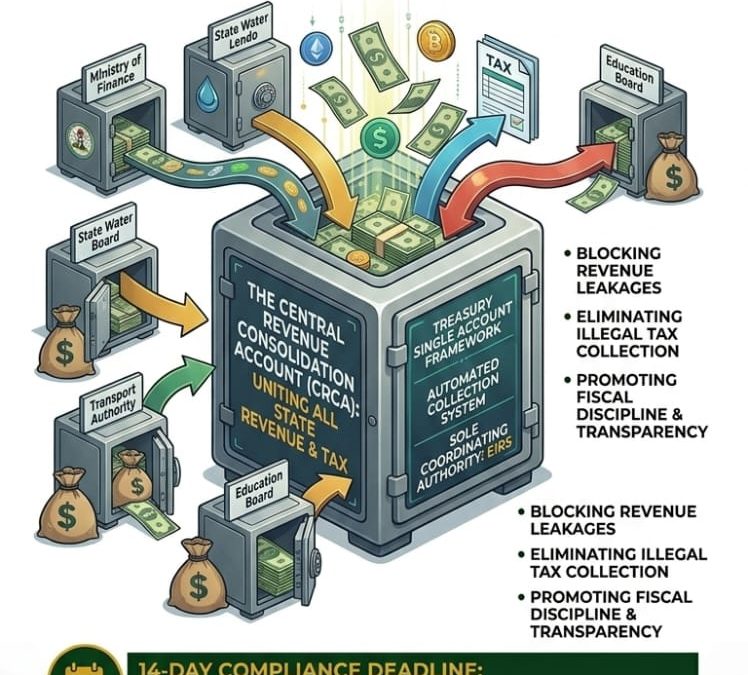
The Edo State Government has officially enacted the Edo State Revenue Consolidation Account (Establishment and Operation) Law, 2026, introducing sweeping financial reforms aimed at centralizing public fund management, blocking revenue leakages, and eliminating illegal tax collection across the state.
In a government special announcement, issued on Wednesday 12th August, 2026 by the Secretary to the State Government, Umar Musa Ikhilor, Esq., revealed that Governor Monday Okpebholo signed the bill into law to enforce strict fiscal discipline, promote transparency, and align the state with broader national tax reforms.
Under the new law, all Ministries, Departments, Agencies, and Parastatals (MDAs) are mandated to dismantle individual operational revenue accounts and centralize all collections under a unified Treasury Single Account framework managed through the Edo State Internal Revenue Service (EIRS).
In addition, the law introduces an administrative and legal framework to govern how state revenues are collected, remitted, and disbursed through the establishing of a central Revenue Consolidation Account for all state funds, eliminating unauthorized retention, diversion, or spending of public revenue at the source by individual government entities, reaffirming the position of the Edo State Internal Revenue Service, EIRS as the sole coordinating authority for revenue enforcement, consultant engagement, and tax administration as well as automating government revenue collection systems to prevent exploitation and streamline processing.
The announcement imposes a 14-day compliance deadline starting August 12, 2026, for all MDAs and state institutions. Within this window, public entities must disclose all existing revenue bank accounts to the Ministry of Finance, transfer all outstanding account balances into the approved Internally Generated Revenue (IGR) account, and permanently close the old operational bank accounts, forward both physical and digital copies of revenue bank statements and supporting records spanning from January 1, 2025, to date to the Ministry of Finance, the Auditor-General (State), and the EIRS for a full forensic revenue audit, halt all independent revenue collection, enforcement drives, and the setup or operation of mobile revenue courts without written approval from the Executive Chairman of the EIRS, and terminate or regularize all existing revenue collection consultants through the EIRS within 60 days, subject to final approval by the Governor of the State.
Furthermore, the state government warned that non-compliance will attract immediate disciplinary action.
“Any Head of Ministry, Department, Agency or Parastatal, Accounting Officer, Director of Finance, Bursar, Treasurer, Principal Officer or any other public officer who fails to comply with the provisions of this law shall be liable to immediate suspension by the appropriate authority pending investigation into the alleged breach.”
It added that any individual or public officer caught engaging in unauthorized revenue collection, diversion, or illegal receipt of state funds will face joint criminal investigation and prosecution alongside any administrative heads who authorized or facilitated the breach.